
Coverage Snapshot
Covers – .
- Articles analyzed
- 134
- Model-flagged
- 11
- Days observed
- 7
Opening Note
The week of August 1 is never a quiet week in Chinese military media. The PLA's founding anniversary reliably produces a surge in platform footage, model-soldier profiles, and doctrinal restatements, and this year's 99th anniversary followed that pattern. The difficulty is sorting rather than volume: which items reflect deliberate strategic messaging, which are artifacts of the annual media cycle, and which document something new about how the PLA is developing and operating.
Three clusters stand out. The first is the Huangyan Island exercise series, which began on August 1 and generated official commentary and press briefing language across the full week. The second is a set of platform disclosures (the Y-20B engine confirmation, H-6N weapons footage, GJ-3A drone debut, and DF-17 formation footage) released through official documentaries and state media around the anniversary. The third is a wave of political work content centered on NUDT researcher Wang Ji, designated a "Model of the Era," which dominated PLA Daily's August 2-8 run and is best understood as an institutional campaign rather than a news event.
All three are real, but none is straightforward to interpret. The Huangyan Island exercises were explicitly linked to a specific Philippine legal act, the submission of nautical charts to the United Nations. That makes them more operationally important than routine South China Sea patrol coverage. The platform disclosures are notable, but they arrived through curated documentary and anniversary footage, which is a format the PLA uses to control what is visible and what is not. And the Wang Ji campaign is extensive enough, running across at least a dozen distinct articles in the week's dataset, to represent a deliberate force-wide messaging effort rather than a profile piece that happened to run large.
By the standards of recent PLA media coverage, this was an important week. Most of the content that mattered, though, was either anniversary-cycle framing or a continued pattern of PLA-CCG coordinated coercion in the South China Sea, neither of which is new, even if specific details this week were.
What Stood Out
The Huangyan Island exercise on August 1, and the sustained official commentary through August 7, stands out as the week's clearest operationally grounded signal.
The Southern Theater Command conducted a maritime and air joint exercise around Huangyan Island explicitly in response to the Philippines drawing territorial sea baselines and separately depositing nautical charts of the feature with the United Nations. PLA Daily reported on August 2 that the exercise included named vessels (the Zhanjiang and Qilianshan), a bomber formation operating from multiple Southern Theater Air Force bases under airborne early warning aircraft control, and a vessel-boarding and hostage-rescue drill simulating the forcible recovery of "detained vessels." That last element extends the documented scope of Southern Theater exercises at Huangyan Island beyond the air and naval strike subjects that have dominated prior coverage.
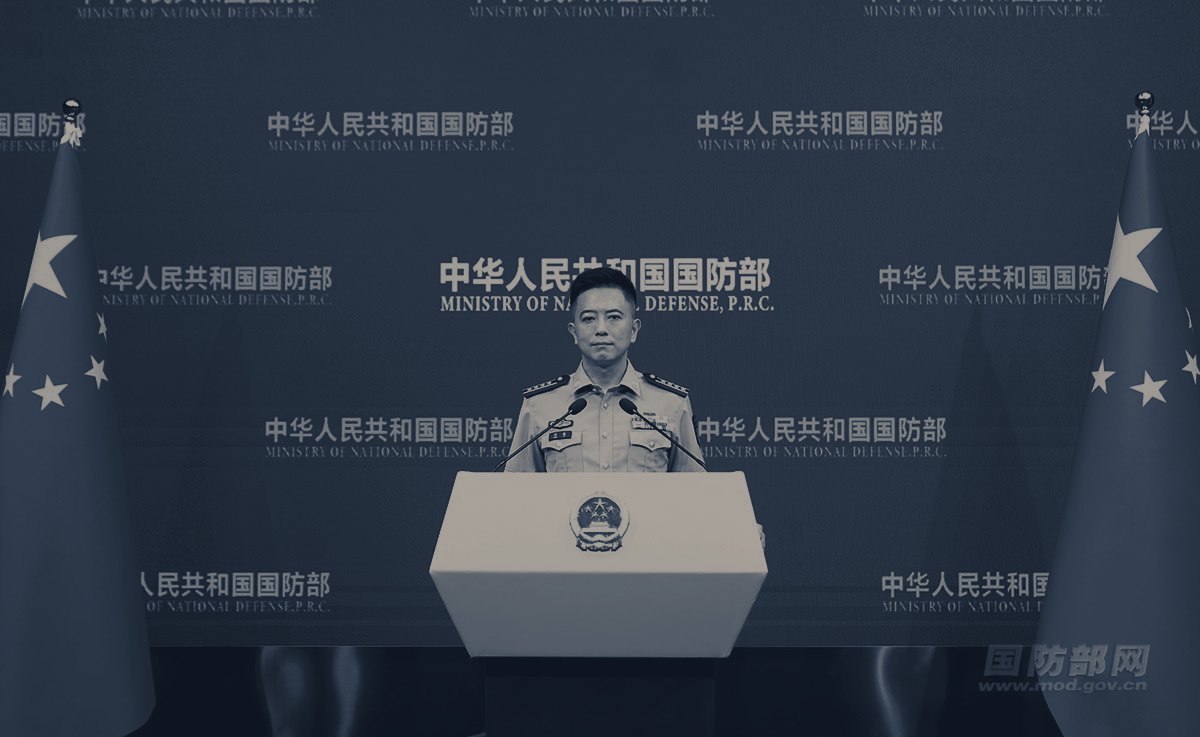
The MND press briefing on August 7 then layered additional framing onto the same event: spokesperson Senior Colonel Chen Xi described the exercises as a "stern warning" against Philippine "sovereignty-infringing and provocative actions," and the China Coast Guard ran parallel rights-protection enforcement drills in the same waters. The pairing of PLA exercises with CCG law-enforcement framing at the same location on the same timeline is now an established instrument. Notable this week is the explicit linkage to a specific Philippine legal act, a UN chart filing, as the stated trigger. The PLA is documenting, in its own official record, that it treats Philippine legal and administrative actions at Huangyan Island as actionable provocations requiring an operational response.
A secondary item stands out: the August 4 Global Times report confirming the GJ-3A drone's public debut alongside a named three-drone intelligent strike-planning system, with footage described as showing cross-service intelligence distribution to the Army, Navy, and Rocket Force. The framing of Air Force unmanned platforms as a sensor layer feeding other services' strike assets documents a joint fires architecture claim that goes beyond what has previously appeared in open reporting. The footage alone cannot confirm operational integration, but the deliberate official disclosure is itself a data point.
Why It Matters
The Huangyan Island exercise pattern matters beyond the exercises themselves. Beijing is building a public record, in its own official media, that specific Philippine administrative and legal actions constitute provocations warranting military responses. The August 1 exercise was framed as a response to baseline declarations, and the August 7 press statement as a response to a UN chart deposit. Each response is documented with official language, a named spokesperson, and coordinated PLA-CCG activity.
This cumulative record is useful to Beijing in two ways. It sets a precedent in its own public justifications: future responses to Philippine moves at Huangyan Island can point back to an established response pattern rather than requiring fresh justification each time. It also reinforces the claim that China alone may define the feature's legal status: the MND statement described the Philippine chart as "null and void" and asserted that only China has the right to draw Huangyan Island's territorial sea baselines.
The vessel-boarding drill is worth holding as a data point. Including a simulated forcible recovery of "detained vessels" in the August 1 exercise does not prove planning for an actual boarding operation, but it documents that the Southern Theater is rehearsing that scenario in the context of Huangyan Island exercises, which is distinct from air defense or surface strike subjects.
On the platform disclosures, the Y-20B's first confirmed operational use with a domestic WS-20 engine matters because it documents progress on a recognized dependency. The original Y-20 fleet relied on Russian D-30KP2 engines; the WS-20 transition has been long anticipated but not previously confirmed in official operational use. The H-6N weapons footage and the DF-17 formation release fit the anniversary deterrence-messaging pattern rather than constituting new capability claims, but they extend the public evidentiary record on both platforms.
Routine Baseline
Two categories of this week's coverage count as routine. Neither is unimportant institutionally, but reading them as operational signals would be a mistake.
The first is the Wang Ji campaign. PLA Daily ran at least a dozen distinct articles across the week profiling Wang Ji, a wheelchair-bound NUDT computer scientist designated a "Model of the Era" by the Central Propaganda Department. The articles range from reporter's notes to political commentaries to unit study-response roundups. The volume is deliberate and coordinated: this is a force-wide ideological campaign, not organic coverage of a researcher. Its analytical value is specific: it documents that the PLA's current political work apparatus is using the figure of the self-sacrificing defense scientist to reinforce messaging around indigenous software development and "chokepoint" technology self-reliance. That is a real institutional signal about what the CMC is emphasizing in this period. The coverage says nothing about what Wang Ji's software actually does, which programs it supports, or whether the campaign reflects a new policy direction or a continuation of existing messaging in a new format.
The second category is the anniversary political work surge more broadly: the "Most Beautiful Revolutionary Soldiers" profiles, the Long March commemorative features, the model-NCO and grassroots Party branch stories. These follow patterns that PLA Daily runs on and around August 1 every year. They are useful as a baseline record of what the institution is framing as exemplary. Technical competence in cyber and space domains has displaced pure ideological virtue in the "Most Beautiful Soldiers" selection criteria this year, which is a real shift. But the individual profiles, the historical narratives, and the 双拥 anniversary content are evidence of what the institution wants junior officers and soldiers to value, not of operational change. That is a different and narrower kind of evidence.
Term to Know
有理有力有节 (Yǒu lǐ yǒu lì yǒu jié)
"Justified, forceful, and measured." This three-part formulation appears in authoritative PLA commentary, this week in the "Junsheng" bylined piece on the Huangyan Island exercise, to frame coercive military action as legally grounded, credible, and calibrated rather than impulsive or escalatory. The phrase has a long history in Chinese political and military discourse, used to describe how the PRC should handle disputes without appearing either weak or reckless. When it appears in PLA Daily commentary alongside a named exercise, it functions as a public signal that the action was deliberate and sanctioned at a high level, and that Beijing is positioning the response within a rule-of-law narrative rather than acknowledging it as coercive pressure. It is a rhetorical claim, not a legal argument, but its presence documents that the institution considered the framing important enough to state explicitly.
What I'm Watching Next
On Huangyan Island, the main indicator to watch is whether the next Philippine administrative or legal move (another UN filing, a new baseline declaration, a fisheries enforcement action) produces a similarly named, similarly scaled exercise response. If it does, the pattern of treating specific legal acts as operational triggers is confirmed. If the PLA response is smaller, delayed, or absent, that would complicate the picture and suggest the August 1 exercise was more about the anniversary context than about the Philippine legal action specifically. The presence or absence of CCG parallel activity alongside any future PLA exercise is a secondary indicator: coordinated dual-track responses have been the format this week, and deviation from that format would be analytically notable.
The Y-20B engine confirmation is the one platform disclosure where a follow-on signal is observable. Watch for further official acknowledgment of WS-20-equipped aircraft in non-ceremonial operational roles: airlift missions, exercises, or escort duties. If the next public appearance of the Y-20B is again in a political-work framing, that would suggest the engine milestone is real but the aircraft is not yet in wide operational service. Named unit assignments or theater-command exercise appearances would be the stronger confirmation.
The GJ-3A and the intelligent strike-planning system were disclosed through documentary footage and Global Times expert commentary. The next meaningful signal would be named unit assignments, or appearance of these systems in PLA Daily's exercise reporting rather than in curated documentary releases. Official framing in a documentary context is not the same as exercise-validated operational integration, and treating it as such would be the most common error here.
Source Trail
13 selected records used in this analysis. Original sources remain authoritative.
- Ministry of National Defense Routine Press Briefing, Early August 2026 2026年8月上旬国防部例行新闻发布
- Y-20B can switch between transport, tanker, other combat roles, PLA documentary reveals Y-20B can switch between transport, tanker, other combat roles, PLA documentary reveals
- PLA Air Force unveils three-drone system with GJ-3A debut, providing intel to Army, Navy, Rocket Force PLA Air Force unveils three-drone system with GJ-3A debut, providing intel to Army, Navy, Rocket Force
- Most Beautiful Revolutionary Servicemembers of the New Era | Navy Fujian Ship Deputy Commanding Officer Wang Tao: Tempering the Sword in the Open Sky, Contending for Supremacy Across the Ocean 最美新时代革命军人风采丨海军福建舰副舰长王涛:长空砺剑 大洋争锋
- PLA documentary debuts H-6N bomber carrying single large missile; weapon capable of anti-ship and ground strikes: expert PLA documentary debuts H-6N bomber carrying single large missile; weapon capable of anti-ship and ground strikes: expert
- Official Chinese media releases rare footage of multiple DF-17 hypersonic missiles in formation, signaling full combat readiness: expert Official Chinese media releases rare footage of multiple DF-17 hypersonic missiles in formation, signaling full combat readiness: expert
- Official documentary reveals PLA Air Force intelligent strike-planning system; experts say it sharpens coordinated combat, shortens strike cycle Official documentary reveals PLA Air Force intelligent strike-planning system; experts say it sharpens coordinated combat, shortens strike cycle
- Junsheng | China's Resolve to Safeguard Sovereignty and Maritime Rights over Huangyan Island Is Unwavering 钧声丨中方维护黄岩岛主权和海洋权益的决心坚定不移
- Southern Theater Command Conducts Maritime-Air Joint Exercise and Training Near Huangyan Island 南部战区位黄岩岛开展海空联合演训
- A Record of the Air Force Deploying Y-20s to Transport Newly Enrolled Flight Cadets to Report for Duty 空军出动运-20运送新录取飞行学员报到侧记
- From 'Each Managing Its Own Segment' to 'Cloud-Network Integration': The Barriers to Data Fusion Have Been Broken 从“各管一段”到“云网一体”,数据融合的壁垒打破了
- The Victory Answer Sheet of the "Underground Dragon Palace" — An Observation Report from a Rocket Force Brigade “地下龙宫”的胜战答卷——来自火箭军某旅的观察报告
- [Bilingual] Ministry of National Defense: The Chinese Military Will Resolutely Counter Any Provocative Attempts to Stir Up Trouble at Sea 【双语】国防部:中国军队坚决反制任何闹海挑衅图谋
Cite this edition
Benjamin Yang, “The PLA Watch: Scarborough Shoal, Platform Disclosures, and the Limits of Anniversary Week,” The PLA Watch No. 13, China Mil Watch, 8 August 2026. https://indopacificrecord.org/the-pla-watch/posts/2026-08-08.html