
Coverage Snapshot
Covers – .
- Articles analyzed
- 53
- Model-flagged
- 1
- Days observed
- 7
Opening Note
What stood out this week was a single official confirmation buried in a routine press briefing, not the volume of training coverage. Most of the 53 articles in this dataset do what PLA Daily does most weeks: document exercises, surface institutional friction and run political education narratives. That is what the publication is for, and it is worth reading on those terms.
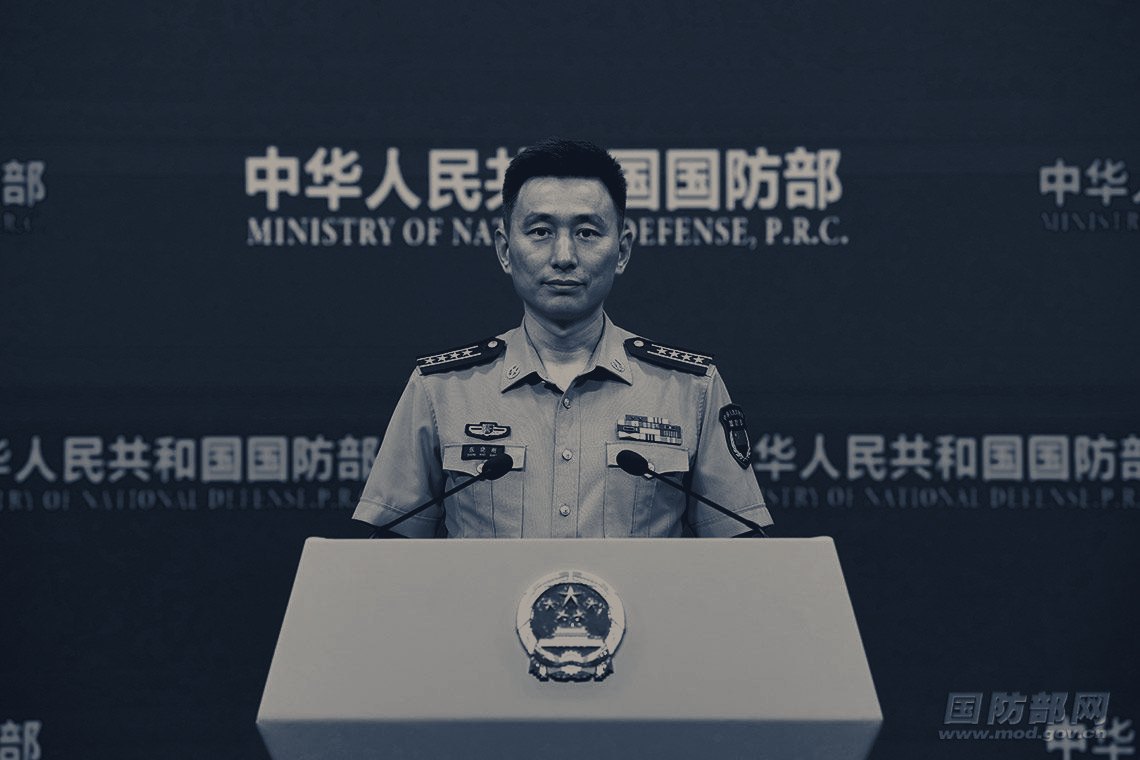
The June 9 MND press briefing was different, though not because of its tone: Zhang Xiaogang's language was measured. It stood apart for what it put on the record. The Liaoning carrier strike group is operating in the Western Pacific, Japan has been tracking it, and Chinese vessels have responded to that surveillance. An institutional confirmation like this turns what might otherwise be inference into documented fact, and it is the one item this week that warrants careful attention rather than the usual baseline-noting.
The rest of the week's coverage extended familiar patterns: aviation units correcting training drift, naval units drilling contested-environment coordination, political work content pushing combat-realistic standards against persistent bureaucratic resistance. None of it is alarming, and all of it is worth tracking as a baseline.
What Stood Out
The June 9 MND press briefing, delivered by spokesperson Zhang Xiaogang, confirmed three things in sequence. Individually they were reportable; together they form the clearest signal of the week. First, the Liaoning carrier strike group is conducting open-ocean training in the Western Pacific, the first official Chinese confirmation of the deployment's scope and current operating area. Second, Japanese forces have repeatedly tracked and surveilled the formation, and Chinese vessels responded "in accordance with laws and regulations", which is Beijing's standard phrase for assertive-but-legally-framed responses. Third, Zhang explicitly characterized Japanese public disclosure of the tracking as inflammatory propaganda rather than legitimate transparency.
The same briefing covered three additional institutional developments worth filing separately. Defense Minister Dong Jun's visit to South Africa was framed as the first by a Chinese defense minister in 12 years and explicitly positioned as a model for Global South military cooperation, a framing that documents Beijing's effort to institutionalize defense relationships outside the U.S.-aligned architecture. The China-Mongolia "Steppe Partner-2026" exercise incorporated manned-unmanned collaborative assault training as a named highlight, extending the record of intelligentized operations integration into bilateral exercises. And a new "5+3" integrated clinical medicine pipeline across the Army, Navy, and Air Force medical universities documents a structural reform to the officer pipeline worth tracking as a baseline for large-scale contingency medical support capacity.
The briefing also documented a coordinated multi-agency gray-zone response to Japan-Philippines maritime delimitation negotiations in waters east of Taiwan: a China Coast Guard law enforcement response paired with a Ministry of Transport special maritime traffic enforcement operation. That pairing fits a pattern of Beijing using overlapping civilian-law enforcement instruments to respond to diplomatic developments in geographically sensitive areas.
Why It Matters
The Liaoning confirmation matters because it moves an operating PLA carrier strike group from inferred to acknowledged. China's official position is that the deployment is routine far-seas training (远海训练), a framing consistent with how the PLA has narrated prior carrier deployments. Less routine is the explicit acknowledgment of Japanese surveillance and the "laws and regulations" response language, a formulation that in PLA usage typically covers everything from verbal warnings to physical intercepts and leaves the actual nature of those responses underspecified.
The broader framing of Japanese disclosure as propaganda rather than transparency also documents Beijing's preferred counter-narrative when foreign militaries publicly report PLA operations: the problem is not what China is doing, the problem is that you are talking about it. That framing has appeared consistently enough across press briefings to qualify as a documented institutional posture rather than a one-off deflection.
The South Africa visit framing is a smaller but distinct data point. Describing it as a model for Global South military cooperation is a deliberate positioning choice that places the visit inside a larger strategic narrative about non-Western defense alignment rather than treating it as bilateral relationship maintenance. Whether the visit produces durable institutional outcomes is a separate question the article does not resolve.
Routine Baseline
Two categories of content dominated the week, and they are worth understanding for what makes them routine rather than what makes them notable.
The first is the combat-realism correction narrative. Articles covering the Northern Theater Command Air Force armed search-and-rescue exercises, the Eastern Theater Command Naval Aviation "Sea-Sky Eagles" division, the Navy general station assessment reform, and the naval aviation unit coordination failure all follow the same structural template: a unit identifies a peacetime training habit that would fail under adversarial conditions, names the specific distortion (crews optimizing for assessment scores, units treating joint integration as optional, commanders avoiding hard training to protect incident-free records), and documents a procedural fix. This pattern has appeared consistently enough in PLA Daily over the past several years that it should be read as an institutional genre: the PLA's preferred method for publicly acknowledging readiness gaps while simultaneously demonstrating corrective action. Individual articles in this category extend the baseline; none proves a capability shift on its own.
The second is grassroots political work content: the instructor who recovered from a public criticism by engaging more directly with enlisted personnel, the fire support company that replaced its honors board with a responsibility chart, the battalion that codified delegation boundaries to reduce over-inspection. These articles serve an internal modeling function: they surface a recognized problem and present a named individual's response as the correct method. They are the PLA's standard mechanism for pushing behavioral norms downward through narrative rather than regulation, not evidence of crisis. Reading them as indicators of dysfunction overstates the signal, and reading them as evidence that no dysfunction exists understates it. These are best read as the categories of friction the institution finds recurring enough to keep writing about.
Term to Know
远海训练 (Yuǎn Hǎi Xùnliàn)
Literally "far-seas training," this is the official PLA framing for carrier strike group and naval formation deployments beyond China's near-seas operating areas, typically into the Western Pacific, the Indian Ocean, or other waters well outside the first island chain. The phrase has two functions. Operationally, it describes a real training objective: PLA Navy formations use these deployments to accumulate blue-water experience in open-ocean navigation, logistics, communications, and multi-domain coordination that cannot be replicated in littoral exercises. Diplomatically, it functions as a deflection label: by characterizing a deployment as "training," Beijing positions any foreign monitoring of the formation as an overreaction to a routine activity. When MND spokesperson Zhang Xiaogang used 远海训练 to describe the Liaoning strike group's current Western Pacific operations, he was invoking both functions at once: confirming the deployment is real while framing concern about it as politically motivated. The phrase is worth tracking because its use in official statements indicates the point at which the PLA decides a deployment is important enough to require public justification.
What I'm Watching Next
The Liaoning strike group's operating area and duration are the obvious thread to follow. Official Chinese statements have confirmed Western Pacific operations and acknowledged Japanese tracking, but it remains unresolved whether this deployment extends the established pattern of shorter far-seas training rotations or represents something with a longer operational timeline. Japanese Self-Defense Force disclosures will likely provide more detail than Chinese official media.
The coordinated CCG and Ministry of Transport response to Japan-Philippines maritime delimitation talks in waters east of Taiwan is worth watching as a potential template. If that multi-agency response (CCG law enforcement paired with civilian maritime enforcement) appears again in response to other diplomatic developments in sensitive areas, it suggests institutionalization of a gray-zone playbook rather than an ad hoc reaction.
The military academy enrollment changes announced at the June 9 briefing, specifically the new NUDT political officer tracks and the 5+3 medical pipeline, are slower-moving but structurally important. Changes to the officer cultivation pipeline take years to produce observable effects, but this is when the baseline gets set. It is worth tracking whether subsequent briefings or academic institution announcements extend or qualify what was announced this week.
Source Trail
13 selected records used in this analysis. Original sources remain authoritative.
- Ministry of National Defense Routine Press Briefing, Early June 2026 2026年6月上旬国防部例行新闻发布
- Warships Ride the Waves, Forging the Sword in Distant Seas: Navy's 48th Escort Task Force Conducts Multiple Targeted Training Events 战舰踏浪、砺剑远洋,海军第48批护航编队开展多项针对性训练
- Military Reporter at the Grassroots | Rescuing Pilots: First Train to 'Pull Teeth from the Tiger's Mouth' 军报记者基层行|抢救飞行员:先练“虎口拔牙”
- A Brigade of the Northern Theater Command Air Force Presents a New Landscape in Armed Search-and-Rescue Training 北部战区空军某旅武装搜救训练呈现新景观
- Guided by Xi Jinping's Thought on Strengthening the Military · Establishing and Practicing a Correct Outlook on Performance Achievements | The New Flight Track of the "Sea-Sky Eagles" 在习近平强军思想指引下·树立和践行正确政绩观丨“海天雄鹰”的新航迹
- China's Peacekeeping Engineer Detachment in South Sudan Earns Commendation for Completing Road Repair Mission 我赴南苏丹维和工兵分队完成道路修复任务获赞誉
- China, Kazakhstan, Kyrgyzstan, Russia, and Tajikistan Conduct New Round of Border Disarmament Treaty Compliance Inspections 中哈吉俄塔开展新一轮边境裁军履约视察
- Tempering the Sword by Starlight! A Close Look at Air Force Aviation Unit Night Flight Training 星夜砺剑!直击空军航空兵夜间飞行训练现场
- Charging Through the Waves! A Frigate Flotilla of the Southern Theater Command Navy Conducts Combat-Realistic Training 踏浪出击!南部战区海军某护卫舰支队开展实战化训练
- "Being Processed" — Processed to What Extent, Exactly? “正在办”,究竟办到哪儿了
- A Glimpse at the Transformation of Military Training Organization Methods 管窥军事训练组训方式之变
- Enhancing Command Capability for All-Domain Operations 面向全域作战提升指挥能力
- Are Medium-Altitude Long-Endurance UAVs Obsolete? 中空长航时无人机过时了吗?
Cite this edition
Benjamin Yang, “The PLA Watch: Combat Realism, Institutional Friction, and One Confirmation Worth Noting,” The PLA Watch No. 6, China Mil Watch, 13 June 2026. https://indopacificrecord.org/the-pla-watch/posts/2026-06-13.html